Veterinary Books Cleanup A Texas clinic and the May report
The practice sits in Dallas. A Texas clinic reaches us the same week on a scheduled call. Thursday stays a federal day, and May is the company report.
Bring one SaturdayThe call starts in Dallas
Dallas is where we sit. Texas clinic owners join us by video, with the afternoon on the screen, and nobody has to cross town for the hour. Someone in Dallas or Fort Worth can use the call as the front door. Someone in another Texas town can use the same hour, and we are all Texans. The Saturday on the screen is the work.
Put the ticket where you can point at it. Steven Palmieri takes the call as Tax CFO, the Entrepreneur's CFO, and the opening question is which charge shared a line with a different kind of work. Visit, groom, medicine, and shelf each need their own answer before a Texas sales tax return is filled. The payroll part of the hour is setup on the provider the clinic already runs. Payday itself stays with that provider.
A bath and an exam on a Texas ticket
Comptroller publication 96-259, dated January 2026 on the page we read, lists the services the state taxes. Dog grooming sits on that list with shoe repair, appliance repair, and jewelry cleaning, as work on tangible personal property. A veterinary exam fee is absent from the categories that publication lists. This page does not invent a statute that exempts the visit. The books still keep the exam on its own line, because a fee that is simply missing from the list is described that way, and a bath that the publication does name is not allowed to hide inside it.
Read the publication before you add a category we did not. The link is publication 96-259. If a later Comptroller page changes the grooming line, the later page wins, and the Saturday split on the ticket stays either way.
A medicine needs the prescription note
Publication 94-155 is the drug page. An over the counter human drug labeled with a Drug Facts panel is exempt under that publication, and the publication says that human exemption does not cover animal products. Drugs and medicines for animals, including flea repellents and dewormers, are exempt only when a veterinarian's prescription is with the sale. Other nonprescription animal drugs are taxable. The invoice or the chart has to show which kind of sale it was. A bottle with no note is not the line that had a note.
The publication is publication 94-155. We keep the note with the line. We do not paste a percentage onto the bottle.
Boarding, feed, and a trail ride
The Comptroller's agriculture and timber FAQ treats horse boarding as a nontaxable service, and riding lessons the same way. A trail ride is taxable as an amusement service on that FAQ. Feed and supplies used to board and care for dogs, or for other animals kept for sport, for show, or as pets, are taxable. The FAQ names kennels as operations that are not a farm or a ranch for the agricultural exemption. A week of boarding on a clinic's books is a stay. It is a different line from the exam, and the feed that went with the stay follows the FAQ rather than a farm rule.
The page is the agriculture and timber FAQ. A clinic that does not board horses can still use the pet feed sentence, because a bag of food at the counter is goods.
The sales tax day is the 20th
The state piece of Texas sales and use tax is 6.25 percent, on most goods and on services the state has put on its list. Anything a city, a county, or a transit board stacks on the state piece is capped, and that cap is 2 percent. One sale cannot be taxed above 8.25 percent all in. Which local piece applies is an address question, answered on the Comptroller rate locator the day the clinic rings the sale. No city percentage is written on this page.
Approval of the permit comes with a letter. That letter is where this page looks to learn whether the clinic files each month, once a quarter, or one time each year. When the letter says each month, take one month of sales and file them on day 20 of the month after. Sales rung in April meet that day on 20 May. Quarterly clinics file four times, in April and in July, and again in October and in January. Clinics whose letter asks for one report a year send the finished year in during January, on the 20th. A due day that lands on a weekend, or on a holiday the Comptroller's offices take, waits until the next morning those offices are open. Check that morning on the due-dates page.
The sales tax penalty on a late clinic report is $50 for the report itself. During the first 30 days the tax is late, the Comptroller adds 5 percent of the sales tax. After those 30 days the add-on is 10 percent of the sales tax. Day 61 is when interest begins, and the percent lives only on the Comptroller interest page. A clinic that files and pays by the due day can take a half percent discount on the tax. Prepaying adds another 1.25 percent on top of that half percent. The half percent and the prepay percent stay on the sales tax instructions, and this page does not copy either figure next to a Saturday ticket.
The closed month has to separate the exam, the groom, the medicine that had a prescription, the nonprescription animal drug, the shelf goods, and any sale a marketplace already collected. Purchases the clinic will resell need a completed Form 01-339. A permit number does not stand in for that certificate. The clinic keeps the certificate. A carrier taken off the shelf for the clinic's own use, rather than sold, is a taxable purchase, the same idea as the Comptroller's broom that left the shelf to sweep the store.
May is the company report
May is when a Texas company reports the privilege of doing business here. That report is the franchise tax. Clinics organized as a professional corporation, a professional association, an S corporation, or a limited liability company are on the filing list, and a company with a single owner is still on it. Treating that company as disregarded on the federal return leaves the Texas report in place. A person who files only a personal return, and who never formed a company around the clinic, is usually outside this May packet.
The franchise packet is aimed at 15 May in an ordinary year. A weekend or a holiday pushes the packet to the next day the office is open. In 2026 that 15 May lands on a Friday, so the Friday stands. In 2027 that 15 May lands on a Saturday, which moves the packet to Monday 17 May 2027. Memorial Day in 2027 is 31 May, so the Monday is not a holiday on the calendar we checked. Still match that Monday against the Comptroller's own calendar in the spring of 2027.
For the reports that cover 2026 and 2027, annualized revenue at or under $2,650,000 means no franchise tax is due and the long form is not the one you file. The reports that covered 2024 and 2025 used $2,470,000. Keep each dollar with its own report year. A year with no tax can still require the short public information report, Form 05-102, or the ownership report, Form 05-167. When franchise tax is actually owed, the retail and wholesale class is usually the 0.375 percent class. A clinic that is not in that class is usually in the 0.75 percent class. The compensation a clinic can count for one person on the 2026 and 2027 row stops at $480,000. The older row stopped at $450,000. Revenue at or under $20,000,000 can use the EZ computation at 0.331 percent, and choosing it means the margin deductions are given up. The four ways to compute margin stay on the Comptroller's franchise pages. This clinic page does not restate them.
File the franchise packet late and the report penalty is $50. Franchise tax that shows up within 30 days after the due day picks up a 5 percent charge. Franchise tax that shows up after that 30 day window picks up a 10 percent charge. Franchise interest begins on day 61. The percent is whatever the interest page shows when you open it, and this sentence does not copy one. Miss the short information report and the company can lose the ability to bring a case or to answer one in a Texas court. Some of the company's debts can become personal for the officers, directors, or owners the statute names. Changing the registered agent is a filing at the Secretary of State, and the May packet is not the form for it. The place to start reading is the franchise instructions the Comptroller posts.
Hours the board will count
Continuing education for a Texas veterinary license was read from a reprint of Title 22, Texas Administrative Code, section 573.64, not from a PDF on the board's own site. The board's continuing education page says active licensees complete hours each year and that the board sets the hours. The reprint is where the counts in this paragraph come from. A veterinarian's renewal asks for 17 hours in the year just before the application. Of those 17, no more than 5 may come from correspondence courses or from practice management courses, and self study hours claimed cannot exceed 3. A veterinary technician's count on that reprint is 10 hours. An equine dental provider's count is 6. Excess hours may carry into the next renewal year only, and not more hours than that next year requires. An owner who spends the whole renewal year in business classes will not fill the clinical requirement. The reprint is section 573.64, and the board overview is the board continuing education page.
Those hours are the licensee's. They are not a material participation test. Publication 925, already named on the questions page, is the federal page for hours in a personal service activity. The two counts answer different offices.
What to have on the call
One Saturday is enough. Bring the ticket with the four charges still visible, the deposit for that day, and whether the month is still open. If a relief clinician was paid, know whether that pay ran through the payroll provider. Wage deposits stay on the calendar of the payroll provider you already use. If the clinic is a company, bring the last May report or the letter that says which short form is yours. If a Comptroller letter named the sales tax rhythm, bring that letter too.
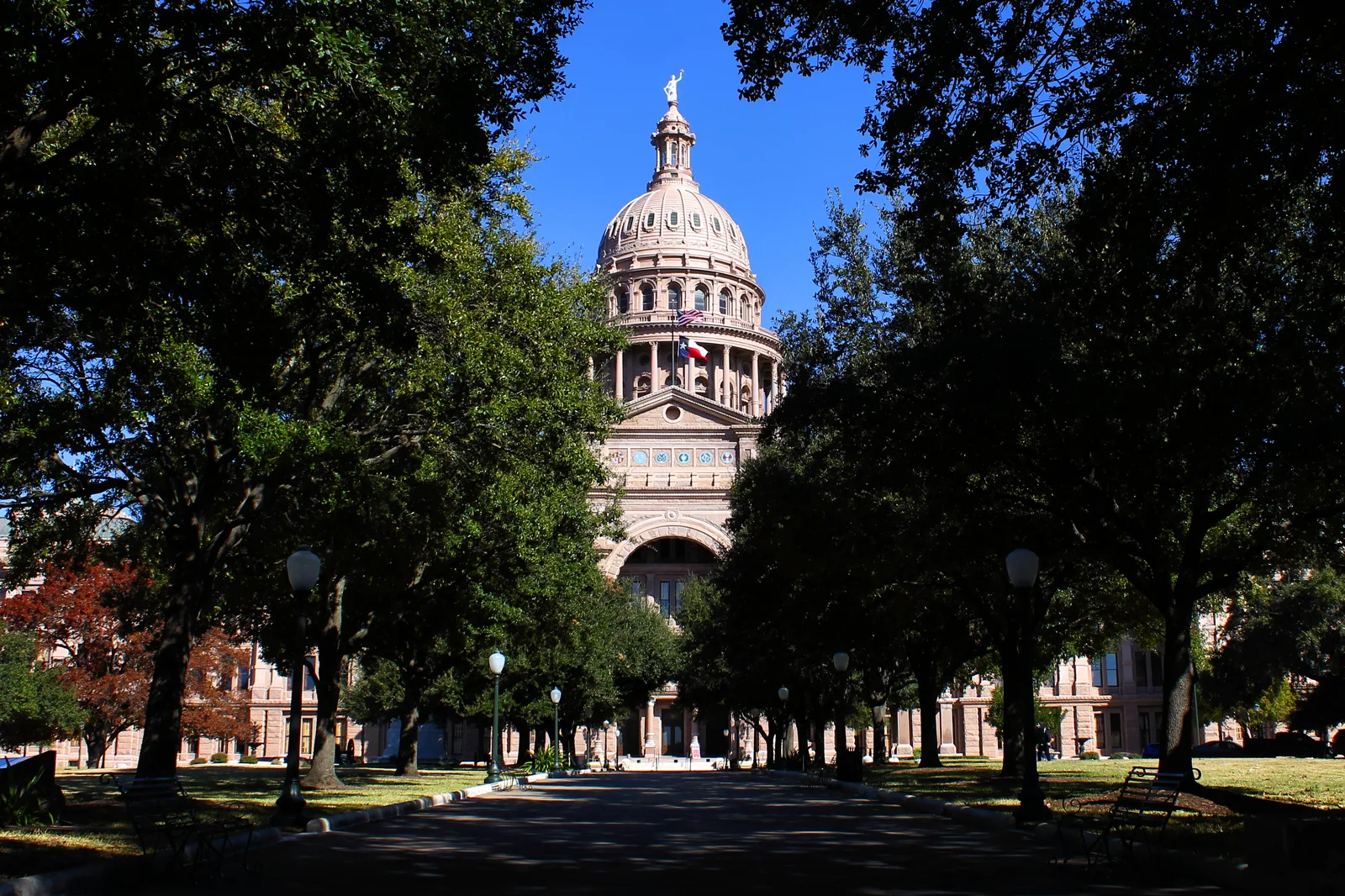
The photograph at the top is the Texas State Capitol, taken from the south walk with the dome above the trees. Larry D. Moore made it and released it on Wikimedia Commons as File:Texas State Capitol from The Great Walk 2020.jpg under Creative Commons Attribution 4.0. We did not take the picture. Austin is where the building stands. Dallas is where you will reach us.
Name the Saturday
 You will be talking to the Steven Palmieri practice.